
The Inner Circle Problem in Scottish Policymaking
How a Narrow Circle of Influential Organisations and Government Funding Limits Debate and Innovation

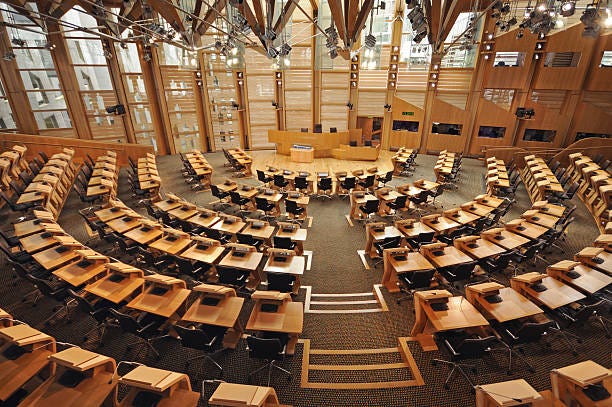
During the Scottish Parliament’s debate on the Right to Recovery Bill, Douglas Ross MSP made an observation that, though easily overlooked in the cut and thrust of parliamentary exchange, raised a profound question about how policymaking works in modern Scotland.
Responding to Patrick Harvie MSP, who warned that the Bill could have “harmful, unintended consequences,” Ross said:
“When I speak about front-line experts, I mean the people who drafted the bill – the people who, day in and day out, see the problems in Glasgow, Edinburgh, Aberdeen, Inverness and Dundee and want to see something happen about them. The ones that I am more suspicious of are those who are funded by the Scottish Government and whose jobs rely on funding from nationalist ministers. They will never be in favour of the bill… However, it is up to us – the democratically elected MSPs in the chamber – to say that although we can consider those views, we need to listen more, debate more and discuss more.”
It was a candid admission, and one that speaks to a deeper structural issue in Scotland’s public life: the extent to which the policy debate is dominated by organisations financially dependent on government.
A Narrowing of Debate
Ross’s comments struck a particular chord with me because of my experience campaigning to modernise Scotland’s stroke awareness messaging.
When I first raised the case for updating the public awareness test from FAST to BE FAST, a small but vital change that would improve detection of strokes. I was told by officials that there was “no evidence” the BE FAST model produced better outcomes in medical settings.
So I gathered the evidence. I studied peer-reviewed research from the United States and Australia, both of which showed BE FAST significantly improves detection rates. I presented those findings to Scottish officials. Their response was that they meant evidence from within Scotland, even though the model has never been trialled here.
That exchange highlighted a deeper problem: an insular, closed approach to evidence. Too often, the Scottish Government and its ecosystem of partner organisations rely on a narrow set of domestic sources that reinforce each other’s assumptions. There is little appetite to look outward, compare performance internationally, or learn from best practice elsewhere.
The result is a policymaking culture that prizes conformity over curiosity.
When Civil Society Becomes Dependent
Ross’s remarks about his “suspicion” of government-funded organisations capture another part of the problem. Scotland’s third sector, once a vibrant and independent civic voice, now operates in large part on public money. That in itself is not objectionable; many charities deliver essential services and deserve public support. But the scale of reliance, and the lack of transparency surrounding it, risk eroding trust.
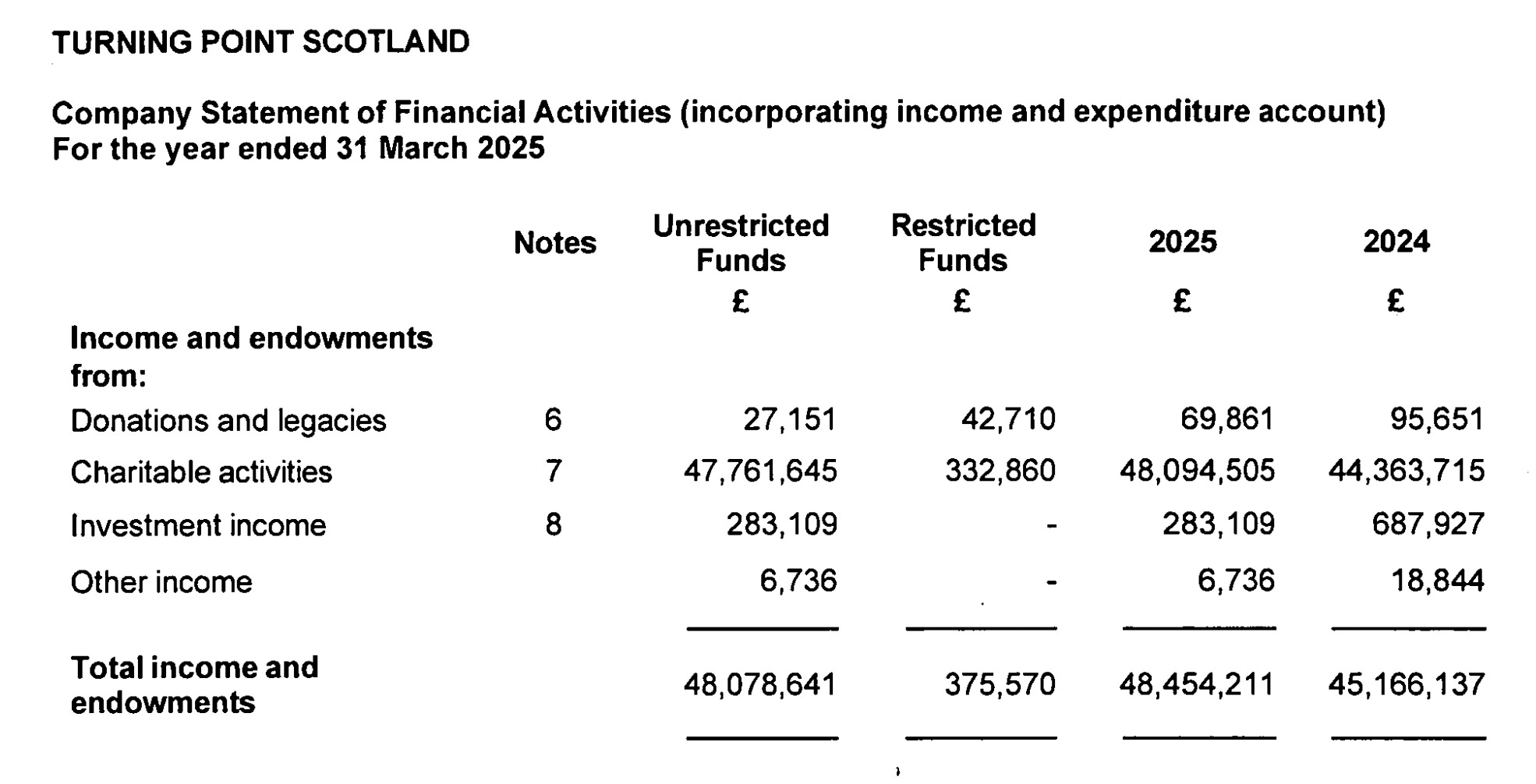
Take Turning Point Scotland, one of the organisations Ross referenced. Its most recent accounts show an income of £48.45 million, of which over £48 million came from “charitable activities” and funding streams that are primarily derived from “Local Authorities, the NHS, Scottish Government and private individuals through self-directed support.” Just £69,861 came from donations or legacies.
Similarly, Alcohol Focus Scotland, between 2018/19 and 2023/24, received £3.78 million of taxpayers’ money. In 2023/24, 80% of its income came from Scottish Government grants. While ministers insist that no conditions were attached to this funding, the organisation has been among the most vocal advocates for increasing the Minimum Unit Price (MUP) from 50p to 65p, despite mixed evidence on the policy’s outcomes.
These cases raise an uncomfortable but necessary question: when the overwhelming majority of a charity’s income depends on the government, can it truly speak independently of that government?
Even if no direct pressure is applied, the incentive structure is clear. Organisations that publicly criticise ministers risk jeopardising future funding. Those that align with government priorities are more likely to secure it. The result is a “soft capture” of civil society, not through coercion, but through dependency.
The Consequences for Public Trust
This dynamic has significant implications for Scotland’s democracy.
First, it weakens scrutiny. When the same organisations that shape policy also rely on government grants, the diversity of evidence before parliamentary committees narrows. Policymakers hear from the same familiar names, funded from the same pot of money.
Second, it damages credibility. Public confidence in charities depends on their perceived independence. When voters see advocacy groups whose funding streams originate in government budgets, it fosters suspicion that official policy is being reinforced by taxpayer-funded echo chambers.
Finally, it diminishes innovation. A healthy civic sector should challenge orthodoxy and test new ideas. But dependence on state funding discourages risk-taking and dissent. In the long run, that weakens both policy quality and democratic legitimacy.
A Practical Solution: Transparency and Diversity
While the funding structures of Scotland’s charitable and civic organisations warrant wider examination, there is an immediate and achievable reform that could begin to restore trust: greater transparency.
All organisations that submit evidence to Parliament, respond to government consultations, or engage directly with MSPs should be required to declare the proportion of their income derived from public funds. This simple measure would ensure that both legislators and the public can assess submissions with a clear understanding of any financial dependencies that may exist.
Such transparency requirements are standard practice in many other democracies. They do not inhibit participation or penalise organisations; rather, they strengthen confidence in the integrity of the policymaking process. Transparency of this kind is not a barrier to advocacy, it is a foundation for trust.
However, transparency alone is not enough. Scotland’s Parliament and Government must also make a deliberate effort to diversify the sources of evidence that inform policy. Committees should look beyond the familiar network of publicly funded bodies and actively seek out international research, academic analysis, and front-line experience from practitioners operating outside government-supported structures.
A wider and more independent range of evidence will lead to more balanced debate, more resilient decision-making, and ultimately, better outcomes for the people of Scotland.
Conclusion: Reclaiming the Spirit of Independence
Douglas Ross’s intervention in the Right to Recovery debate has opened a long-overdue discussion about how policymaking in Scotland is shaped. His remarks may have been politically contentious, but the issue they expose reaches far beyond party politics.
If Scotland aspires to a policy environment that is genuinely evidence-led, plural in perspective, and independent in thought, it must confront the quiet but corrosive problem of financial dependency within its civic sector.
Rebuilding trust will not come through grand institutional reforms or rhetorical commitments to openness. It will come through a series of modest but principled steps: greater transparency around funding, a willingness to engage with international and independent evidence, and a renewed respect for those who challenge prevailing assumptions.
For campaigners working on issues such as stroke care, this independence is not abstract, it determines whether new ideas are given fair consideration. When government confines its attention to a narrow circle of familiar organisations and advisers, those with established access and influence, innovation is stifled. Reforms such as updating the FAST test to BE FAST risk rejection not because they lack evidence, but because they fall outside the comfort zone of the policy establishment.
Scotland can and should do better. A confident democracy must be prepared to hear from every credible voice, not only those within the inner circle. Restoring that confidence is the first step toward a healthier, more open, and more effective system of governance, one capable of learning, adapting, and delivering for the people it serves.
Superb piece, James. 👏
You’ve named what so many of us have seen up close for years, the quiet capture of Scottish public life by a closed circle of government-funded insiders. It’s not conspiracy, it’s culture: a revolving door of “consultation” and “evidence” that always lands in the same hands.
Those of us who’ve tried to bring front-line recovery experience or independent data into the debate know exactly how that wall feels. It’s not that they argue, it’s that they exclude.
Your call for transparency and diversity of evidence is spot-on. Until we face the dependency problem in the third sector, policymaking will stay trapped in a taxpayer-funded echo chamber.
Excellent analysis, thank you for putting it so clearly. 👏
#RightToRecovery #Scotland #Policy #Accountability
I think you are onto something important about the public campaigning of organisations heavily dependent on Scottish government funding. I support full disclosure of that funding, at the very least.
Some of these organisations, such as the Rape Crisis centres, also deliver important services. In many respects, they are more like quangos than normal charities, but their effectiveness is not subject to review by, e.g. the Audit Commission or Parliamentary Committees.
In fact, there seems to be no process by which the continuation of funding for all these organisations can be publicly assessed. I cannot see why a charity which gets more than 50% of its income from the government should not be treated like other quasi-official bodies.